What Is Tarot Card Reading Explained

So, what exactly is a tarot card reading?
Forget dusty crystal balls and cryptic predictions whispered in a dark room. At its heart, tarot is a powerful tool for self-reflection—a way to have a candid conversation with your own intuition using a deck of beautifully illustrated cards.
Think of it like this: you know that complex feeling you can't quite put into words? Language sometimes falls short. Tarot steps in with a rich tapestry of symbols and universal archetypes, giving a voice to what you might already sense deep down. It’s not about predicting a sealed fate; it's about unlocking a fresh perspective.
Your Guide to Understanding Tarot
This practice actually has a surprisingly down-to-earth history. Long before it became a go-to for introspection, tarot kicked off its journey in 15th-century Italy as a simple parlor game. Fast forward to today, and its role as a wellness tool is absolutely booming. The global tarot cards market is projected to soar by a staggering USD 209.7 million between 2025 and 2029—a clear testament to its timeless appeal.
It’s a dynamic method for tapping into your own inner wisdom, and the first step is understanding how this incredible deck actually works.
The Anatomy of a Modern Tarot Deck
A standard tarot deck is a complete system of 78 cards, artfully designed to explore the entire spectrum of human experience. Every single card represents a universal theme, an emotion, or a situation we all face at some point on our journey.
The deck is smartly divided into two main sections: the Major Arcana and the Minor Arcana.
- The Major Arcana: These 22 cards are the heavy hitters. They represent major life events, profound spiritual lessons, and the core archetypes that shape your journey. Think of them as the pivotal, can’t-miss chapters in the story of your life.
- The Minor Arcana: These 56 cards brilliantly fill in the details. They reflect the everyday situations, challenges, and joys that make up those chapters. Just like a regular deck of playing cards, they are divided into four distinct suits.
A tarot reading is a form of storytelling. The cards themselves don’t hold all the answers. Instead, they provide the prompts and symbols that help you build a narrative around your own life, unlocking insights you might have otherwise missed.
To make this structure even clearer, here's a simple breakdown:
Anatomy of a Modern Tarot Deck
| Component | Number of Cards | Primary Focus |
|---|---|---|
| Major Arcana | 22 | Major life events, spiritual lessons, and archetypal themes. The "big picture" of your journey. |
| Minor Arcana | 56 | Everyday situations, challenges, emotions, and practical advice. The details of daily life. |
Seeing the deck this way—as a structured, elegant tool—demystifies the process and makes it much more approachable and exciting.
Mapping Your Inner World
Picture a tarot deck as a detailed map of your own emotional and psychological landscape. The Major Arcana cards are the major landmarks—the mountains you must climb and the deep valleys you need to navigate. The Minor Arcana cards are all the winding roads, flowing rivers, and shifting weather patterns you encounter along the way.
Ready to see how the cards reflect your own path? You can explore personalized answers with expert readers and start your journey at https://askyourtarot.com/.
Exploring the Major and Minor Arcana
To really grasp what a tarot reading is all about, you have to peek inside the deck. The 78 cards aren't just a random jumble of pictures; they're a complete storybook of the human experience, split into two deeply connected parts: the Major and Minor Arcana. Together, they create the narrative framework that makes a reading so incredibly potent.
Imagine it this way: the Major Arcana reveals the grand, cosmic themes of your life, while the Minor Arcana fills in the everyday details that make those themes real. You can't have one without the other if you want the full, vibrant story.
This diagram helps illustrate how the entire 78-card deck is organized.
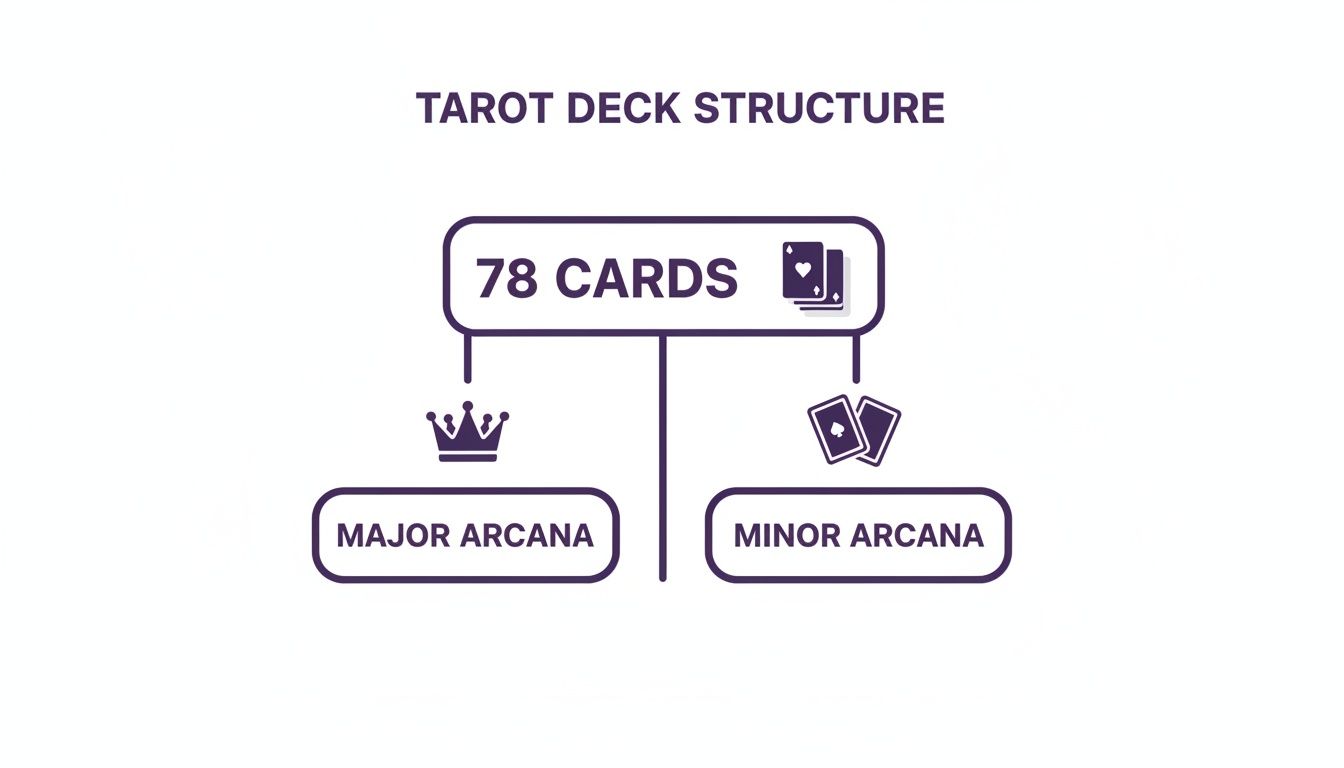
This structure makes it clear that while the deck works as a single, cohesive tool, it's built from two fundamental card types, each playing a unique and vital role in a reading.
The Major Arcana: Your Spiritual Journey
The 22 cards of the Major Arcana are the heart and soul of the deck. They map out a profound journey of self-discovery, representing the major milestones, spiritual lessons, and archetypal forces that shape who we are. Think of them as the pivotal chapters in your personal epic.
This journey begins with Card 0, The Fool, symbolizing that exhilarating leap of faith into the unknown. It then moves through powerful archetypes like The Empress (nurturing creativity), The Emperor (building order), and The Lovers (making soul-defining choices).
Each card builds on the one before it, guiding you through tough spots like The Tower (sudden, necessary chaos) and moments of deep insight like The Hermit (solitary reflection). The journey culminates with Card 21, The World, which signals completion, wholeness, and the triumphant end of a major life cycle.
When a Major Arcana card appears in a reading, it’s a cosmic nudge to pay close attention. It’s pointing to a significant life lesson or a major energetic shift happening right now—something that demands your full awareness.
These cards are the big picture—the powerful currents guiding your path over the long haul.
The Minor Arcana: The Currents of Daily Life
While the Major Arcana sketches out the epic, the 56 cards of the Minor Arcana color in the rich, everyday details. They reveal the practical situations, thoughts, feelings, and circumstances that make up your daily reality. If the Major Arcana cards are the mountains and valleys, the Minor Arcana cards are the winding paths, flowing streams, and changing weather you encounter along the way.
These 56 cards are broken down into four suits, each one connected to a specific area of life.
Wands: This suit is all about action, passion, and creativity. Think of wands as sparks of inspiration—they represent ambition, raw energy, personal growth, and the drive to make things happen. When a Wand card appears, it often relates to your career, passion projects, or creative fire.
Cups: The Cups suit rules the world of emotions, relationships, and intuition. These cards explore feelings of love, joy, loss, and connection. They are the heart of the deck, asking you to look at how you relate to others and, most importantly, to yourself.
Swords: Representing the mind, the Swords suit deals with thoughts, communication, challenges, and beliefs. These cards often illuminate moments of conflict, hard decisions, and profound clarity. They speak to your intellect and the power of your words and ideas.
Pentacles: This suit is grounded in the material world. Pentacles relate to your finances, work, physical health, and home life. They represent the tangible parts of your existence, from your career path to your relationship with nature and the physical environment.
Each of these four suits contains 14 cards: an Ace through Ten, plus four Court Cards (Page, Knight, Queen, and King). The numbered cards usually show how events unfold within their suit's theme, while the Court Cards often represent people, personality types, or different ways of approaching a situation. Understanding this structure helps you see how a tarot reading artfully weaves life’s biggest lessons together with its most ordinary moments.
How Does a Tarot Reading Actually Work?
A tarot reading is far more than just flipping over a few cards and hoping for the best. It's a structured ritual, intentionally designed to bring focus and clarity to your most pressing questions. Each step gracefully builds on the last, turning a simple deck of cards into a powerful tool for looking inward.
Think of it as setting the stage for a deeply meaningful conversation. You wouldn't just dive in without knowing what you want to talk about. A tarot reading starts the same way—with a clear purpose—to ensure the insights you receive are genuinely helpful.
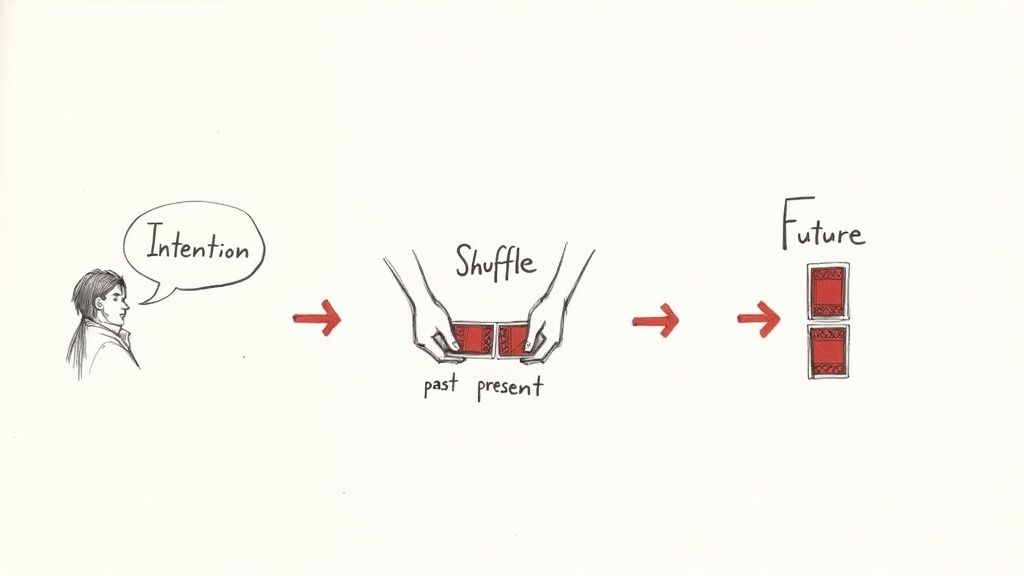
This simple flow—setting an intention, shuffling, and laying out the cards—is the backbone of every single reading, whether you're pulling one card for the day or sitting down for an in-depth exploration.
Tuning Into Your Question
First things first: you have to set your intention or frame your question. This is the most crucial step because it creates the energetic focal point for the entire reading. It’s like tuning an old-school radio to a specific frequency; if you don't find a clear station, all you're going to get is static.
A great question opens the door to a great answer. Vague questions or simple yes/no prompts usually lead to confusing or unhelpful results. Instead of asking, "Will I get the promotion?" try something more empowering, like, "What can I focus on to advance my career?" See the difference? One passively asks for a fixed outcome, while the other actively seeks actionable guidance.
This kind of self-reflection is surprisingly common. A May 2025 Pew Research report found that 30% of American adults use tools like tarot or astrology every year, with 10% specifically turning to tarot cards for a fresh perspective. You can discover more insights about these global psychic trends to see just how mainstream this practice has become.
Shuffling and Connecting with the Cards
Once your question is clear in your mind, it’s time to shuffle the deck. This is so much more than just mixing up the cards. It’s a physical act that infuses your personal energy and your specific question into the deck. While you shuffle, hold that question in your mind and let your thoughts and feelings blend with the cards.
There's no single "right" way to do it. Some people like a neat, controlled overhand shuffle. Others prefer to spread the cards all over the table in a messy pile and mix them up that way. The method isn't nearly as important as the mindful intention you bring to it.
Shuffling is a meditative moment. It’s your chance to quiet the outside world and center your focus, creating a bridge between your conscious thoughts and the symbolic language of the tarot.
When you feel like the cards are ready—a feeling that’s pure intuition—it’s time to stop and draw them for your spread.
Using Spreads to Create a Story
A tarot spread is simply the pattern in which you lay out the cards. It’s not random. Each position in a spread holds a specific meaning, which adds a crucial layer of context to whatever card lands there. Think of it as a story outline or a sentence structure for the cards' messages.
Spreads provide the framework that transforms a handful of individual card meanings into a cohesive, insightful narrative. They give your reading direction and make the insights much easier to organize and understand.
If you’re just starting out, keep it simple. Here are two of the most common and effective spreads out there:
The Three-Card Spread: This is the go-to for a reason. It's incredibly versatile and perfect for getting quick, clear insight into a situation. The cards are laid out from left to right, representing:
- Position 1: The Past – What events or energies led to the current situation?
- Position 2: The Present – What is the heart of the matter right now?
- Position 3: The Future – Where are things potentially headed?
The Celtic Cross Spread: This one is a bit more involved, but it’s a classic for deep dives. It’s a ten-card spread that gives you a truly comprehensive look at a situation from all angles. You’ll explore the core issue, its challenges, hidden influences, your hopes, and potential outcomes. It might look intimidating at first, but it follows a logical path that uncovers layers of insight a simpler spread could miss.
By following these simple steps, a tarot card reading becomes a clear, repeatable process for gaining a deeper understanding of your own life.
Interpreting Cards Through Storytelling
Once the cards are on the table, the real magic begins. This is where you move from the practical act of shuffling to the beautiful art of interpretation. It’s less about rigidly memorizing definitions from a book and more about becoming a storyteller.
Each card is a scene, packed with symbols, energy, and potential. Your job is to weave these individual moments into a story that speaks directly to the question you asked. Imagine being handed three random pictures—a crumbling tower, a shining star, and a focused artisan—and being asked to connect them into a single, meaningful narrative.
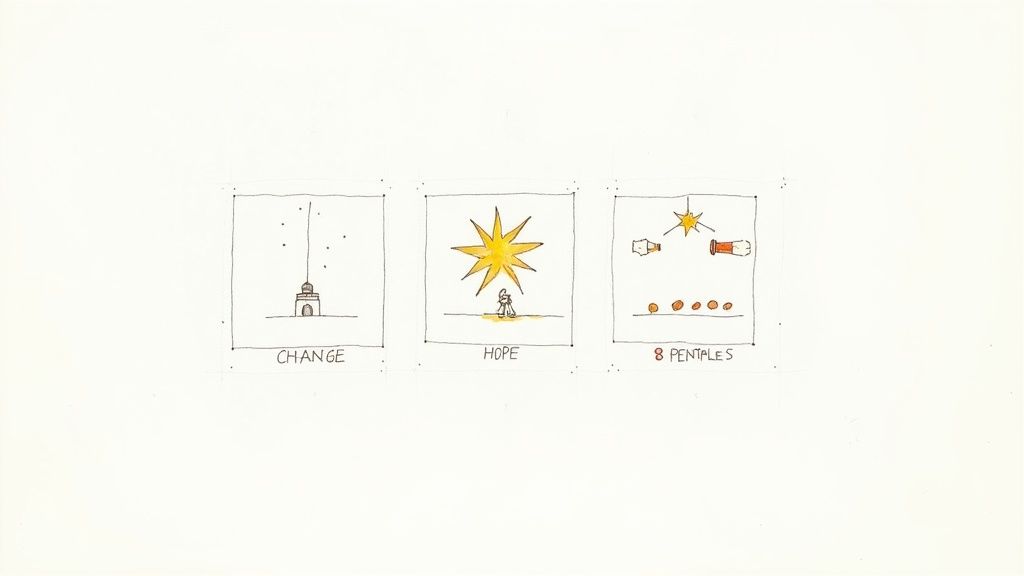
The power isn't in the cards themselves; it’s in the connections you make between them, guided by your own intuition and the context of your life.
Connecting Symbols to Your Situation
A truly great reading breathes life into the cards by linking their universal symbols to your personal situation. The King of Cups doesn't just represent emotional maturity in a vacuum. If you’re asking about a difficult colleague, he might be a gentle nudge to be the calm, compassionate leader in the room.
The key is to look at the imagery and ask: what does this feel like? What does it remind me of? How does this picture speak to what I’m going through right now?
Tarot interpretation is an intuitive dialogue. The cards offer a symbolic language, and you translate it into personal wisdom by blending traditional meanings with your own life experience and inner knowing.
This approach transforms a reading from a rigid exercise into a fluid, personal, and deeply insightful conversation. It’s the difference between just reciting a poem and actually feeling what it means.
A Practical Example: A Career Question
Let’s walk through a quick three-card reading to see how this storytelling works in action. Imagine you’re feeling stuck in your job and ask the cards, “What do I need to understand about my career path right now?”
You decide on a simple Past-Present-Future spread and pull three cards:
- The Tower (Past)
- The Star (Present)
- Eight of Pentacles (Future)
Instead of seeing them as three separate messages, you connect the dots. A reader might interpret this combination as a powerful story of recovery and growth. Let's see how that narrative gets built.
Example Three-Card Reading for a Career Question
Here's one way to translate those three cards into a cohesive, empowering story.
| Card Position | Example Card Drawn | Possible Interpretation in Context |
|---|---|---|
| Past | The Tower | "Something recently fell apart unexpectedly. This could have been a sudden layoff, a project collapsing, or the harsh realization that your old career path was built on a shaky foundation." |
| Present | The Star | "After that chaos, you are now in a phase of healing and renewed inspiration. You're starting to see a new, more authentic way forward and feeling a sense of hope again." |
| Future | Eight of Pentacles | "Your path ahead involves dedicating yourself to mastering a new skill or honing your craft. This points to focused, diligent work that will lead to tangible results and real expertise." |
Putting it all together, the story is crystal clear. A recent, disruptive event (The Tower) has actually cleared the way for a period of hope and vision (The Star). The guidance for the future is to channel that inspiration into dedicated, practical work to build something solid and meaningful (Eight of Pentacles).
This narrative offers so much more than three separate definitions ever could. This is the heart of a tarot reading: a personalized story that illuminates your path and empowers your next steps.
Preparing for Your First Reading
Getting your first tarot reading is an exciting step, but a little prep work can make a huge difference. Think of it like preparing for a really important conversation—the more present and clear you are, the more you'll get out of it. A thoughtful approach can turn a good session into a truly eye-opening one.
Your main job is to show up calm, curious, and open. Taking a few deep breaths or even doing a quick meditation before you start can quiet down all that mental chatter. This helps you connect better with both the reader and the cards, ensuring the guidance you receive really hits home.
Finding a Reputable Reader
Who you choose to read for you is a big deal. A trustworthy reader is a guide, not someone who's going to dictate your future. As you search for the right person, it helps to know what red flags to watch for.
Be wary of anyone who uses fear to get you to buy more services or who promises you guaranteed outcomes. An ethical reader knows the future isn't set in stone; you always have free will. Their job is to illuminate your path, not predict unavoidable doom or sell you a winning lottery ticket.
A few clear warning signs include:
- Guaranteed Predictions: No one can promise a 100% certain outcome. Life is a dynamic, evolving story.
- Fear-Based Tactics: If they tell you you're cursed or that something awful is coming unless you pay up, walk away. Fast.
- Upselling Spells or Rituals: Your reading should be complete on its own. Feeling pressured to buy an expensive "curse removal" is a massive red flag.
- Vague Generalizations: A good reader will tie the cards directly to your situation, not just give you generic fortunes that could apply to anyone.
An ethical tarot reading should leave you feeling empowered and clear, not anxious and dependent. The reader is there to offer perspective, helping you make your own best decisions.
Always trust your gut when you're choosing. If something feels off or you feel pressured, it's completely okay to find someone else.
Crafting Questions That Spark Insight
The quality of your questions completely shapes the quality of your answers. It's so tempting to ask simple "yes or no" questions, but they really limit what you can learn. The best questions are open-ended—they invite guidance and explore possibilities instead of just asking for a static prediction.
For example, instead of asking, "Will I get the new job?" try reframing it. Something like, "What can I do to align myself with the best career opportunities?" is infinitely more powerful. This simple shift changes the focus from a passive outcome to your active role in creating your future.
Consider these kinds of empowering questions:
- What do I need to understand about...?
- How can I best navigate...?
- What is the primary lesson for me in this situation?
- What important perspective am I currently missing?
When you frame your questions this way, you allow the cards to act like a mirror, reflecting what's going on inside you and showing you the path forward. If you're stuck on how to phrase something, a good reader will be more than happy to help you figure it out.
If you're looking for an expert to guide you, you can explore options and get in touch with trusted advisors on our contact page. A well-crafted question is the key to unlocking a truly meaningful tarot session.
Where Tarot Thrives Around the World
When you learn to read tarot cards, you're not just picking up a new skill—you're stepping into a global conversation that's been unfolding for centuries. While its story began with a card game in Italy and took root in France, tarot’s modern identity as a tool for self-reflection has built a vibrant worldwide community. The practice isn’t stuck in one culture; it bends and adapts, mirroring the unique spirit of every place it touches.
You can see it in the cozy tarot cafes scattered around Paris or feel it in the buzz of digital readings connecting a seeker in New York with a guide in Tokyo. It's a practice that feels both ancient and completely contemporary, fitting seamlessly into countless different lives.
Hotspots of Tarot Interest
Tarot's appeal spans continents, and a quick look at search trends and cultural surveys reveals just how wide its reach is. Central and southern Europe, particularly France and Spain, are powerhouses of interest, leading the world in searches for "tarot." In fact, a BVA poll found that a staggering 43% of French citizens consider French Tarot one of their favorite card games, showing how deeply it’s woven into daily life, even beyond divination.
Over in the Americas, Argentina and Chile show some of the highest search volumes, while the United States and Australia maintain a strong, steady interest. You can discover more insights about these global psychic trends and see how different countries connect with practices like tarot.
This isn't just some fleeting trend; it's part of a much bigger shift toward wellness and looking inward.
Understanding tarot's global reach is deeply reassuring for a beginner. You're not just learning some niche hobby—you're joining a diverse, centuries-old conversation. The cards are a shared language of symbols, connecting people across cultures who are all asking the same profound questions about their lives and their paths.
When you sit down with your deck, you're tapping into a tradition that has offered perspective to people all over the world for generations. That shared history makes the journey of learning tarot feel that much more meaningful.
Your Top Tarot Questions, Answered
Even after getting the basics down, it’s completely normal to have a few more questions rattling around. Let's clear up some of the most common uncertainties people have when they first dip their toes into the world of tarot. A little clarity goes a long way in helping you approach this journey with confidence and an open mind.
Is Tarot Just Fortune-Telling?
While pop culture loves to paint tarot as a crystal ball predicting unavoidable doom and gloom, that’s not really what modern readers are about. Think of it less like predicting a fixed, unchangeable future and more like exploring the potential paths branching out from where you stand right now.
The cards act like a mirror. They show you the energy you're working with, highlight possibilities you might not have considered, and empower you to make conscious, informed choices. It’s all about guidance, not prophecy.
Can I Read Tarot Cards for Myself?
Absolutely! In fact, pulling cards for yourself is one of the best ways to learn their rich symbolic language and strengthen your own intuition. It creates a deeply personal and powerful connection to the deck.
While getting a reading from a professional offers a valuable outside perspective, self-reading is how you connect directly with your own inner wisdom. A simple daily card pull is a fantastic way to start. It's a low-pressure habit that helps you learn the meanings and observe how the cards reflect your everyday life.
Do I Have to Be Psychic to Read Tarot?
Not at all. You don’t need to have any special psychic gifts to become a great tarot reader. At its core, tarot is a skill built on learning symbolism, recognizing patterns, and mastering the art of weaving a story.
Everyone has intuition. Reading tarot is simply a fantastic way to tune into it and make it stronger.
Think of it like learning a new language. At first, you’ll probably rely on a dictionary (your guidebook), but with enough practice, you start to understand the flow and meaning intuitively. It’s a skill anyone can develop with an open mind and a little patience.
What if I Get a "Scary" Card?
Seeing cards with intense names like Death, The Devil, or The Tower can definitely be jarring, but they almost never point to literal, physical events. In tarot, these cards represent major life themes and powerful moments of transformation.
The Death card, for example, usually signifies a necessary ending that’s clearing the way for a beautiful new beginning. The Tower often represents a sudden, disruptive change that ultimately sets you free from a false foundation. These cards aren't warnings of doom; they are powerful invitations to look deeper at the significant shifts happening in your life. You can explore the philosophy behind our approach by learning more about us and our mission.
At askyourtarot, we connect you with trusted experts who can provide clear guidance for the questions that matter most. Get personalized answers within 12 hours. Start your reading today.