8 Essential Tarot Spreads for Beginners to Unlock Your Intuition
Welcome, future card-slinger! If you've just unwrapped your first tarot deck, the vibrant imagery and potent symbolism can feel like holding a universe in your hands—both thrilling and a little intimidating. You're likely asking, "What now?" The real magic isn't just in the individual cards; it's in the stories they weave together. Tarot spreads are the layouts, the narrative frameworks that turn a single card's whisper into a clear, insightful conversation. They provide structure for your readings, helping you ask focused questions and receive guidance that truly resonates.
Forget feeling overwhelmed by complex diagrams or the sheer number of possibilities. This guide is your secret map. We’ve curated a collection of foundational tarot spreads for beginners designed to help you build confidence, sharpen your intuition, and get meaningful answers right from the start. From a simple daily check-in to exploring the intricate dynamics of a relationship, each spread is a practical tool for your tarot toolkit.
Think of each layout as a stepping stone on your intuitive path. You'll learn how to connect with your deck, understand the meaning behind each card's position, and weave a cohesive narrative from the images before you. This list provides the essential structures you need to move from a hesitant shuffler to a confident reader. So, let's lay the cards on the table and begin your journey.
1. One Card Pull
The One Card Pull is the heart of tarot reading and the perfect place for any beginner to start. Deceptively simple, this method involves drawing a single card to receive a focused message, a flash of insight, or a theme for your day. It’s one of the most direct tarot spreads for beginners, helping you build a personal connection with your deck one card at a time without the overwhelm of complex layouts.

When to Use This Spread
This spread is your versatile go-to. It's ideal for those moments when you need a quick, clear answer or a single point of focus to cut through the noise.
- Daily Guidance: Start your morning by asking, "What energy should I carry with me today?" or "What hidden opportunity should I watch for?"
- Quick Decisions: Facing a small crossroads? Ask, "What is the energy surrounding option A?"
- Emotional Check-in: Feeling a strong but murky emotion? Ask, "What truth is this feeling trying to show me?"
How to Perform a One Card Pull
- Hold your deck: Take a few deep breaths, quiet your mind, and focus on your question or intention.
- Shuffle the cards: Shuffle in whatever way feels natural while keeping your question held firmly in your mind.
- Draw a card: When the moment feels right, cut the deck and pull one card from the top, or fan the cards out and let your intuition guide your hand to the one that calls to you.
- Interpret the message: Gaze at the imagery, symbols, and traditional meaning of the card. How does its story answer your question?
Tips for Interpretation
To unlock the deepest wisdom from your single-card draw, keep your questions open-ended. Instead of asking a "yes/no" question, frame it with "what," "how," or "why." This invites a more nuanced and insightful conversation with the card. Journaling your daily pulls can also reveal powerful patterns and messages from the universe over time. To deepen your understanding of this foundational practice, you can get insights on the One Card Pull at askyourtarot.com.
2. Three Card Spread
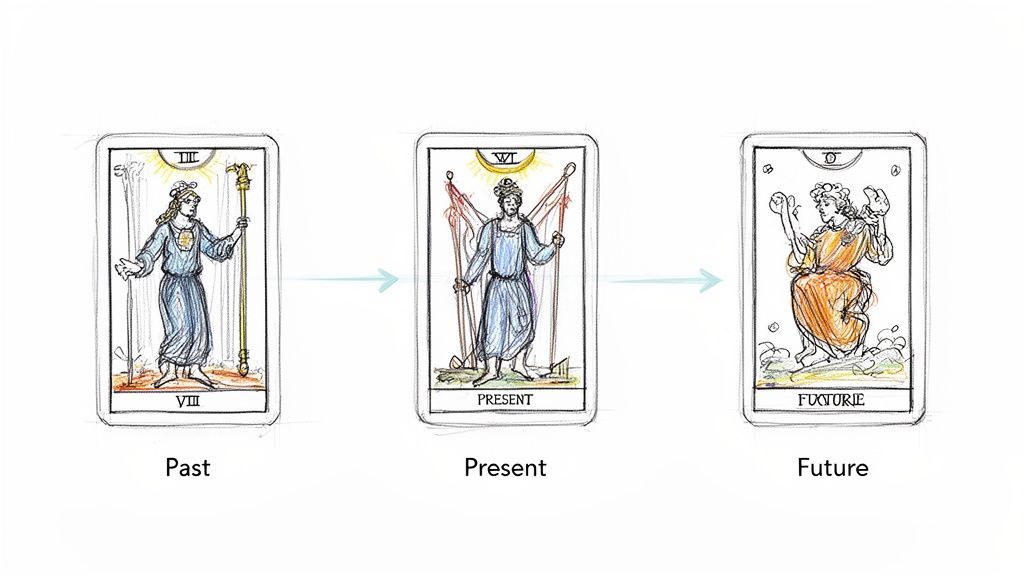
Ready to level up? The Three Card Spread is arguably one of the most versatile and beloved tarot spreads for beginners. It expands the narrative by creating a simple, compelling story through the interplay of three cards. This spread provides vital context and a sense of progression, allowing you to see a situation's flow without getting lost in a complex layout. Its sheer adaptability makes it a cornerstone practice for readers at every level.
When to Use This Spread
The true beauty of the Three Card Spread is its chameleon-like flexibility. By assigning different meanings to each position, you can tailor it to almost any question imaginable.
- General Life Path: Use the timeless Past / Present / Future framework to understand where you've been, where you are, and where you're headed.
- Problem-Solving: Frame your query with Situation / Action / Outcome for clear, actionable advice that empowers you.
- Relationship Dynamics: Explore a connection using You / The Other Person / The Relationship to see the full picture from all sides.
- Holistic Check-in: A Mind / Body / Spirit spread offers a brilliant snapshot of your overall well-being.
How to Perform a Three Card Spread
- Define your positions: Before you shuffle, decide what story you want the cards to tell. Will they be Past, Present, Future? Or something else?
- Focus and shuffle: Hold your deck, concentrate on your question, and shuffle the cards until your intuition whispers, "Stop."
- Draw the cards: Cut the deck and draw three cards, placing them from left to right in a horizontal line.
- Interpret the story: Read each card individually according to its position. Then, step back and see how they talk to each other to create the overarching narrative.
Tips for Interpretation
The secret to a powerful three-card reading is clarity. Decide on the meaning of each card position before you draw to avoid any post-deal confusion. Look for repeating numbers, suits, or symbols across the cards—these are clues to a central theme. Pay attention to the flow from one card to the next; this reveals the story's momentum and direction. To gain a deeper appreciation for this foundational spread, you can explore more about the Three Card Spread on askyourtarot.com.
3. Five Card Spread
Moving beyond the trusty trio, the Five Card Spread offers a more comprehensive narrative without becoming overwhelming. This versatile spread, often arranged in a cross or a simple line, provides a balanced look at a situation by examining it from multiple angles. It’s one of the best tarot spreads for beginners who are ready to start exploring the intricate relationships between cards and see a bigger, more detailed picture unfold.
When to Use This Spread
This spread is your perfect partner for when you need a multi-faceted view of a specific problem, relationship, or personal challenge. It adds layers of delicious context that a simpler spread might miss.
- Career Assessment: Use it to explore your current role, identify hidden obstacles, spot shimmering opportunities, and find the best path forward.
- Relationship Insight: Gain clarity on a dynamic by examining each person's perspective, the heart of the relationship, its main challenge, and its potential future.
- Personal Growth: Ask about a personal block, what feeds it, the advice you need, the underlying lesson, and how to achieve a breakthrough.
How to Perform a Five Card Spread
- Define your positions: Decide on the roles for each of the five cards before you shuffle. A classic cross layout is: 1 (Center) The Heart of the Matter, 2 (Left) The Past/Challenge, 3 (Right) The Future/Potential, 4 (Bottom) The Unseen Foundation/Advice, and 5 (Top) The Overall Outcome.
- Focus and shuffle: Concentrate on your question as you shuffle the cards in a way that feels right to you.
- Lay out the cards: When you feel ready, cut the deck and draw five cards, placing them in their predetermined positions.
- Interpret the story: Read each card according to its position, then observe how they connect and interact to form a complete, cohesive narrative.
Tips for Interpretation
Before you begin interpreting, jot down what each position represents so you don’t forget. Look for elemental balance: are there a lot of fiery Wands (action), emotional Cups (feelings), airy Swords (thoughts), or earthy Pentacles (material world)? Pay special attention if a Major Arcana card appears in a key position—it signals a major life theme is at play. If you're struggling to connect the dots or crave a deeper understanding, you can always get in touch with an expert tarot reader at askyourtarot.com.
4. Celtic Cross Spread
The Celtic Cross is one of the most famous and comprehensive tarot spreads in existence. While its ten cards might look intimidating at first, it offers a rich, detailed story about a specific situation, making it a powerful tool once you've mastered simpler layouts. It’s one of the classic tarot spreads for beginners looking to graduate from basic readings and dive deep into the interconnected forces shaping their lives.
When to Use This Spread
This spread is best reserved for when you need a thorough, soul-deep exploration of a significant issue. It’s not for quick daily draws but for the complex, tangled questions that require a panoramic view.
- Major Life Decisions: Use it when contemplating a huge transition, like a career change, a cross-country move, or a new chapter in life.
- Comprehensive Relationship Analysis: Gain profound insight into the dynamics of a partnership, uncovering hidden challenges and potential paths forward.
- General Life Reading: When you feel stuck but aren't sure why, this spread can provide a detailed map of your current life path and all its influences.
How to Perform a Celtic Cross Spread
- Focus your intent: Hold your deck and concentrate on the complex situation or question you wish to unravel.
- Shuffle and cut: Shuffle the cards thoroughly, meditating on your query, then cut the deck.
- Lay out the ten cards: Place the cards in their traditional positions, forming a cross shape with a vertical staff to its right. The positions typically represent:
- The Present Situation (The Heart of It)
- The Immediate Challenge (What Crosses You)
- The Past/Foundation (The Roots)
- The Future (What Lies Ahead)
- Conscious Goals/Beliefs (Above You)
- Unconscious Influences (Below You)
- Your Role/Attitude (Your Power)
- External Environment/Influences (Your World)
- Hopes and Fears (Your Inner Guide)
- The Final Outcome (The Resolution)
Tips for Interpretation
The key to unlocking the Celtic Cross is understanding how the cards speak to each other. The "challenge" card (position 2) is especially crucial, as it directly impacts the present situation (position 1).
Don’t feel pressured to absorb the entire story at once. Sit with each card and its position individually before weaving them into a cohesive narrative. It's wise to build up to this spread after getting comfortable with 3 to 5 card layouts. Keeping a guide with the position meanings handy is a brilliant way to learn without the pressure.
5. Horseshoe Spread
The Horseshoe Spread is a classic seven-card layout that offers a comprehensive yet totally manageable narrative. Arranged in a graceful arc, this spread provides a detailed look into a situation's past, present, and future, making it one of the most insightful tarot spreads for beginners ready to explore more complex dynamics. It beautifully bridges the gap between simple three-card pulls and larger, more intricate layouts.
When to Use This Spread
This spread truly shines when you need a well-rounded overview of a specific problem or journey. It's perfect for gaining clarity on situations that have many moving parts.
- Understanding a Challenge: Ask, "What do I need to understand about this obstacle I'm facing?"
- Relationship Dynamics: Explore a connection by asking, "What is the true dynamic between myself and this person?"
- Project Planning: Gain insight into a new venture with, "What is the potential path of this project?"
How to Perform a Horseshoe Spread
- Focus your intention: Clearly define the situation you want to explore. Take a few calming breaths to center yourself.
- Shuffle and cut: Shuffle your deck while concentrating on your question. Cut the deck when your intuition gives you the nod.
- Lay out the cards: Draw seven cards and place them in a horseshoe or arc shape from left to right.
- Read the positions: Interpret each card according to its specific role in the story:
- Card 1: The past influences shaping the situation.
- Card 2: The present situation, right now.
- Card 3: The near future, or what is currently developing.
- Card 4: The best course of action or advice.
- Card 5: The influence of others or external factors.
- Card 6: Your hidden hopes and fears about it all.
- Card 7: The likely final outcome.
Tips for Interpretation
The magic of the Horseshoe Spread is in its narrative flow. Read the cards in order to watch the story unfold from past to future. Pay close attention to the central card (Card 4)—it often represents the pivotal turning point or the core piece of wisdom you need to hear. This spread is a fantastic opportunity to practice interpreting both upright and reversed cards, as the context of each position provides a strong framework for understanding their varied meanings.
6. Yes/No Spread
While tarot is famous for its nuanced, soul-stirring guidance, sometimes you just need a straightforward answer. The Yes/No Spread is designed for exactly those moments, providing a clear directional response to a specific, closed-ended question. It's one of the most practical tarot spreads for beginners looking for quick validation or a simple green light, cutting through complexity to deliver a direct message.
When to Use This Spread
This spread is your go-to when you're facing a binary choice or need a quick gut-check before taking action. It works best when ambiguity isn't helpful, and a direct answer is needed to move forward with confidence.
- Immediate Decisions: "Should I make this purchase today?" or "Should I attend this event tonight?"
- Assessing Situations: "Is this job offer the right move for me right now?"
- Gauging Potential: "Will this project succeed if I stick to my current plan?"
- Checking Intuition: "Is this person being honest with me?"
How to Perform a Yes/No Spread
- Focus your question: Hold your deck and concentrate on a single, clear question that can be answered with a "yes" or "no."
- Shuffle the cards: While shuffling, repeat your question in your mind to infuse the deck with your energy and intention.
- Draw a card (or three): For the simplest version, pull one card. For a little more nuance, pull three cards and place them in a row.
- Interpret the message: Determine the "yes" or "no" based on the card's nature or a system you decide on beforehand. If using three cards, the majority rules.
Tips for Interpretation
Getting a clear answer depends entirely on setting clear rules before you draw. Decide on your method first. For example, you might designate all Major Arcana cards as a strong "Yes," while Minor Arcana cards suggest a "No" or a less definite outcome. Alternatively, some readers use numerology: odd numbers mean "Yes," and even numbers mean "No." When a reversed card appears, it often signifies a "not right now," "maybe," or a sign that you need to rephrase your question.
7. Four Card Foundation Spread
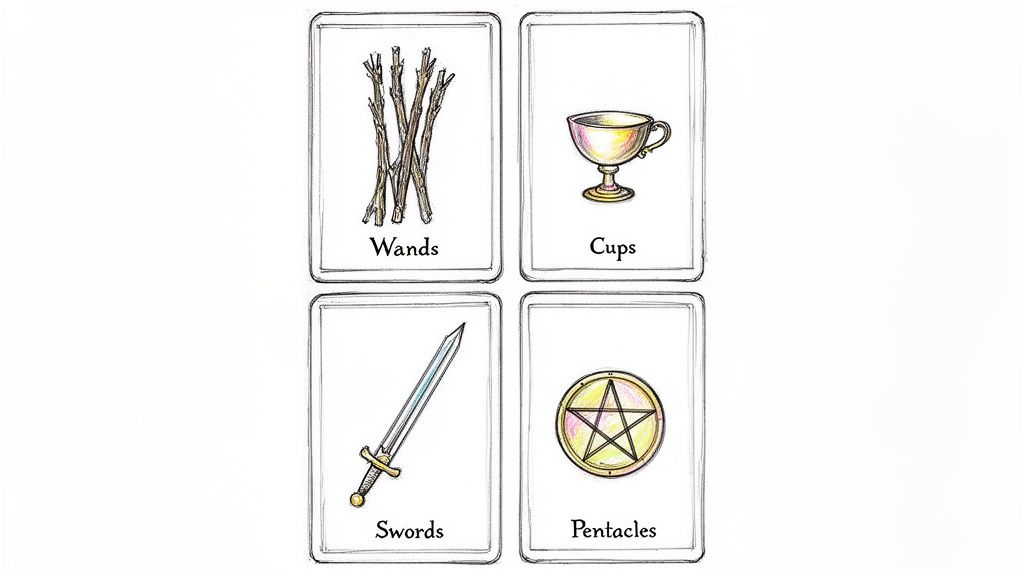
The Four Card Foundation Spread is an exceptional tool for understanding how different areas of your life interconnect. It cleverly uses the four suits of the tarot to represent distinct domains: Wands for action and career, Cups for emotions and relationships, Swords for thoughts and challenges, and Pentacles for the material and physical world. As one of the most structured tarot spreads for beginners, it provides a holistic snapshot of your current life balance.
When to Use This Spread
This spread is perfect when you feel a general sense of imbalance or just want a high-level overview of your life. It helps you pinpoint which areas are craving more attention and which are currently thriving.
- Life Balance Check: Ask, "What is the current state of my energy across my work, love life, thoughts, and finances?"
- Weekly Forecast: At the start of the week, ask, "What should I focus on in each major area of my life this week?"
- Personal Assessment: Use it for a periodic self-reflection by asking, "Where do I stand right now in my personal, emotional, mental, and physical realms?"
How to Perform a Four Card Foundation Spread
- Set Your Intention: Quiet your mind and focus on the desire for clarity about your overall life balance.
- Shuffle the Cards: Shuffle your deck thoroughly, holding the intention of your reading in your heart.
- Lay Out the Cards: Pull four cards and place them in a square or a horizontal line. Assign each position to a suit's domain:
- Card 1 (Wands): Action, Passion, Career
- Card 2 (Cups): Emotions, Relationships, Creativity
- Card 3 (Swords): Thoughts, Challenges, Communication
- Card 4 (Pentacles): Material World, Finances, Health
- Interpret the Messages: Analyze each card in its assigned position, then look at the spread as a whole to see the connections, harmonies, and imbalances.
Tips for Interpretation
The real genius of this spread comes from comparing the cards. For instance, a challenging card in the Swords position (thoughts) next to a joyful card in the Cups position (emotions) might suggest your own mindset is undermining your relationships. This layout is a fantastic teaching tool for memorizing the core energies of the four suits, providing a practical framework for your learning journey.
8. Two Card Comparison Spread
When you're standing at a crossroads with two distinct paths stretching out before you, the Two Card Comparison Spread offers clear and direct insight. This is one of the most practical tarot spreads for beginners because it brilliantly simplifies decision-making by placing two options side-by-side. It creates a powerful visual contrast, allowing you to weigh the energies, potential outcomes, and hidden themes of each choice.
When to Use This Spread
This spread is your best friend for any "this or that" scenario. It excels at bringing laser-focused clarity when you feel stuck between two equally compelling or confusing alternatives.
- Career Decisions: "What is the potential of staying at my current job versus accepting the new offer?"
- Relationship Choices: "What is the energy surrounding reconciliation versus the energy of moving on?"
- Life Path Questions: "Should I pursue my creative passion or a more stable career path right now?"
How to Perform a Two Card Comparison Spread
- Assign your options: Before shuffling, clearly decide which position represents which choice. For example, "The card on the left is Option A, and the card on the right is Option B."
- Focus and shuffle: Hold your deck, state your question aloud or in your mind, and shuffle the cards while focusing on the two alternatives.
- Draw two cards: When you feel ready, cut the deck and draw two cards, placing them side-by-side according to your initial assignment.
- Compare and interpret: Analyze each card individually first, then bring them into conversation. How do their energies interact? Do they complement or clash?
Tips for Interpretation
The true magic here is in the comparison. Look for connections and contrasts. Does one card seem significantly more positive or challenging than the other? Notice if the figures in the cards are facing toward or away from each other—this can suggest harmony or conflict between your choices. Trust the story the two cards tell together to illuminate your decision.
8 Beginner Tarot Spreads Compared
| Spread | Implementation Complexity 🔄 | Resource Requirements ⚡ | Expected Outcomes 📊⭐ | Ideal Use Cases | Key Advantages 💡 |
|---|---|---|---|---|---|
| One Card Pull | Very low — single-card draw | Deck; 1–2 min; no memorization | Quick daily guidance; limited depth | Daily practice, quick yes/no, beginners | Fast, portable, builds card familiarity |
| Three Card Spread | Low — three positions, flexible frameworks | Deck; 3–5 min; basic position knowledge | Balanced narrative; more nuance than one card | Career/relationship snapshots, quick decisions | Easy to learn; versatile; quick depth |
| Five Card Spread | Moderate — five positions to remember | Deck; 5–10 min; moderate position recall | Comprehensive overview; multiple perspectives | Situational analysis, multi-factor decisions | Good balance of clarity and depth |
| Celtic Cross Spread | High — ten positions with defined meanings | Deck; 15–30 min; significant memorization/study | Thorough, in-depth analysis; complex insights | Major life decisions, deep personal readings | Industry standard; rich interpretive framework |
| Horseshoe Spread | Moderate — seven positions, chronological arc | Deck; 8–12 min; recall seven meanings | Informative journey narrative; mid-level nuance | Personal growth, project timelines, love readings | Visually intuitive; balances nuance and clarity |
| Yes/No Spread | Very low — 1–3 cards binary format | Deck; 1–5 min; requires clear question framing | Direct binary answers; may miss nuance | Quick decisions, simple yes/no queries | Fast, straightforward, easy for beginners |
| Four Card Foundation Spread | Low — four elemental positions | Deck; 5–8 min; basic suit correspondences | Holistic life-balance snapshot across suits | Teaching suit meanings, weekly check-ins | Teaches elemental structure; organized and simple |
| Two Card Comparison Spread | Low — two contrasting positions | Deck; 2–3 min; minimal memorization | Clear comparison between options; limited context | Binary option comparisons, choosing between two paths | Focused, quick, highlights contrasts effectively |
When Your Cards Need a Co-Pilot
You've now explored a foundational toolkit of tarot spreads for beginners, from the simple clarity of a One-Card Pull to the epic narrative of the Celtic Cross. Each spread is a unique lens, a structured framework to help you translate the symbolic language of tarot into actionable wisdom. By practicing these layouts, you're not just memorizing card positions; you are building a deep, personal relationship with your deck and, more importantly, with your own powerful intuition.
Think of these spreads as conversational prompts. The Three-Card Spread offers a quick check-in on your journey, while the Horseshoe Spread provides a detailed, seven-step action plan. The Four Card Foundation Spread helps you get to the root of a challenge, and the Two Card Comparison Spread brings clarity to difficult choices. Mastering these simple structures is the key to unlocking more complex and nuanced readings down the line. It's the practice of laying out the cards, asking specific questions, and patiently listening for the story that transforms a beginner into a confident reader.
Recognizing When You're Too Close to the Question
As you continue your journey, remember that the goal isn't just to interpret cards—it's to gain clarity. There will be times, however, when a situation is too emotionally charged or tangled to see clearly on your own. Reading for yourself on matters of deep heartbreak, major career changes, or confusing relationships can feel like trying to navigate a storm without a compass. Your own hopes, fears, and biases can inadvertently color your interpretation, leading to more confusion instead of less.
This is a normal and natural part of learning. Recognizing when your personal feelings are clouding your judgment is a sign of advanced self-awareness, not failure. It’s in these moments that seeking an external, objective perspective becomes an act of profound self-care. A professional tarot reader acts as that co-pilot, offering an unbiased view from a different altitude. They can illuminate blind spots you didn't know you had, validate the intuitive nudges you were second-guessing, and offer a clear, compassionate interpretation free from the emotional fog. This doesn't replace your personal practice; it enhances it, providing a guiding light when your own feels dim.
Feeling stuck on a major life question or need a second opinion on a complex reading? The experienced, vetted advisors at askyourtarot specialize in providing the compassionate clarity you need. Book a reading today and let a professional co-pilot help you navigate your path forward.