A Modern Guide to Tarot Reading for Beginners
So, you’re curious about tarot. Fantastic. It can feel like you’re about to learn a secret language, but here's the truth: it’s far more intuitive than you think. Let's get one thing straight right away: you don't need to be a psychic to read the cards. A tarot reading is a conversation with yourself, and the cards are brilliant prompts to help you unlock the wisdom you already have.
Starting Your Tarot Journey Without the Overwhelm
Does the thought of memorizing 78 different card meanings make your head spin? Let’s reframe that. Don't think of a tarot deck as a textbook you have to cram for. Think of it as a visual storybook of the human experience. Each card is a chapter, a character, or a scene that mirrors a piece of your own life.
At its heart, tarot is a powerful tool for self-reflection. The deck is a mirror, helping you see situations from angles you hadn't considered before. People aren't just using tarot to peek into the future anymore; they're using it for profound personal growth and to find clarity in the here and now.
Why Tarot Is Having a Moment
If you’re feeling a pull toward the cards, you're in excellent company. The practice has seen a huge surge in popularity, especially among people just starting out. A Pew Research report found that 30% of U.S. adults use tools like tarot cards at least once a year.
What's really fascinating is who's leading the charge. The same report showed that 24% of Americans aged 18-29 engage with tarot annually, proving this ancient practice has found a firm, vibrant footing in the modern world.
This guide is designed to make your first steps into tarot feel simple and grounded. We'll break down exactly what you need to know to start reading with confidence.
Tarot isn't about someone telling you your future; it's about helping you create it. The cards provide a roadmap of possibilities, allowing you to navigate your path with more awareness and intention.
What You Can Expect to Learn Here
This is all about forging a personal connection with your cards. Forget getting bogged down in complicated rituals or rigid rules. We’re focusing on practical, actionable steps to get you started on your journey.
By the end of this guide, you will know how to:
- Understand the Deck's Structure: Learn the difference between the Major and Minor Arcana without getting lost in the weeds.
- Ask Better Questions: Discover how to phrase your questions to get insightful, genuinely helpful answers.
- Do Your First Reading: Follow a simple, step-by-step process to pull cards and start making sense of their messages.
- Trust Your Intuition: Go beyond the little white book and learn to hear the unique stories the cards are telling you.
To get started, it helps to have a few key things on hand. This isn't about spending a lot of money, but about setting yourself up for a meaningful practice.
Your Tarot Reading Starter Kit
| Component | Why It's Important for Beginners |
|---|---|
| A Tarot Deck | Choose one with art that speaks to you. A deck you connect with visually will make learning much easier and more intuitive. |
| A Journal | Writing down your readings, questions, and interpretations is the fastest way to learn and track your progress. |
| A Quiet Space | You don't need an altar, just a calm spot where you won't be interrupted for a few minutes. This helps you focus. |
| An Open Mind | This is the most important tool. Be open to what the cards show you, even if it's not what you expected. |
With these simple elements, you have everything you need to begin.
Think of this as your first friendly chat with your new deck. Whether you’re looking for answers about your career, relationships, or personal growth, a whole world of insight is waiting for you. And if you ever want to see how the pros do it, you can find a wealth of guidance with services like those at AskYourTarot.
Ready to begin? Let's pull some cards.
Getting to Know the Structure of Your Tarot Deck
Holding a tarot deck for the first time can feel like being handed a story with 78 different characters. How are you supposed to get to know them all? The good news is, you don’t have to learn them all at once. Like any great novel, the deck has a clear structure that clicks into place once you see how it’s organized.
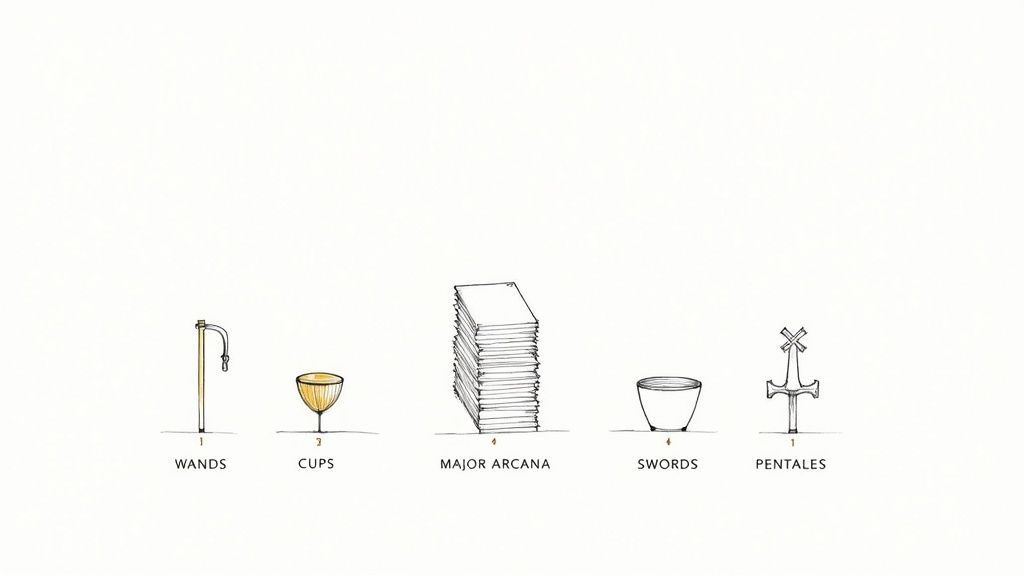
Instead of trying to memorize 78 individual cards, it’s much easier to think of the deck in two main parts: the Major Arcana and the Minor Arcana. These two sections work together to tell a complete story about the human experience—from our biggest life lessons down to our everyday moments.
Understanding this split is the first real step in any tarot reading for beginners. It gives you a simple framework that turns a pile of cards into a system that actually makes sense.
The Major Arcana: Your Spiritual Compass
The Major Arcana is a set of 22 cards, numbered 0 to 21, that represent life's big, universal themes. Think of them as the major chapters in your story—the huge turning points, spiritual lessons, and powerful energies we all encounter eventually.
These cards show up for moments like falling in love (The Lovers), facing a massive choice (The Chariot), or going through a deep personal transformation (Death). When a Major Arcana card appears in a reading, it’s like a spotlight hitting the stage. It's a signal that the situation holds a much deeper, more important lesson for you.
For example, pulling The Fool (card 0) almost always points to the start of a brand new journey full of unknown potential. On the other end, The World (card 21) represents the successful finish line of that journey, a moment of real fulfillment and wholeness.
The Minor Arcana: Scenes from Daily Life
While the Major Arcana paints the big picture, the Minor Arcana fills in all the vibrant details. This section has the other 56 cards, and they reflect the day-to-day stuff—the activities, challenges, thoughts, and feelings that make up our lives.
If the Major Arcana is the "what" and "why" of your situation, the Minor Arcana is the "how" and "who." These cards give context to the bigger themes, showing you how they’re playing out through your actions, relationships, and daily routines. This is where the real nitty-gritty of a reading often comes to light.
To make things even easier, the Minor Arcana is split into four distinct suits, just like a regular deck of playing cards. Each suit is connected to a specific area of life, which makes their meanings way more intuitive to figure out.
By breaking the deck into the Major Arcana (the "why") and the Minor Arcana (the "how"), you can start to see tarot not as a bunch of random symbols, but as a dynamic storytelling tool that reflects the complexity of your own life.
The Four Suits and What They Mean
The four suits are your key to unlocking the Minor Arcana. When you connect each suit to a core part of being human, the cards stop feeling so abstract and start feeling personal.
- Wands (Fire Element): This suit is all about passion, energy, creativity, and drive. Wands cards often have to do with your career, personal projects, and that spark of inspiration that gets you moving. It’s your inner fire.
- Cups (Water Element): This suit rules the world of emotions, relationships, intuition, and love. When Cups cards show up, they're usually talking about matters of the heart, your connections with other people, and your emotional state.
- Swords (Air Element): This suit represents your thoughts, beliefs, communication, and challenges. Swords cards deal with logic, truth, and conflict—the mental battlefield where you make decisions and face your struggles.
- Pentacles (Earth Element): This suit is tied to the physical, material world. It covers money, work, health, and your home—all the tangible, practical parts of your life.
By understanding this simple structure—Major Arcana for the big themes, Minor Arcana for daily life, and the four suits for specific areas—you've already built a solid foundation for your tarot reading for beginners practice. You're no longer just looking at a card; you're seeing where it fits into the bigger story.
How to Perform Your First Tarot Reading
You've learned the deck's structure, and now the real adventure begins. This is the moment theory turns into practice, and your deck transforms from a collection of cards into a powerful tool for self-discovery. Performing your first reading isn’t about elaborate rituals; it’s about creating a quiet space for a conversation with yourself.
Let's walk through the simple, tangible steps to conduct your first reading. This whole process is designed to build your confidence and demystify pulling cards. By the end, you'll have a straightforward routine you can use anytime you need a little clarity.
Setting the Stage for Your Reading
Before you even touch the cards, the first step is to get into a focused mindset. You don’t need candles or incense unless they help you feel grounded. The real key is finding a quiet moment where you can be present without the usual distractions.
Take a few deep breaths. Let go of the day's stress and center your thoughts on the question or situation you want to explore. This simple act of pausing helps you approach the reading with intention, making the insights you get feel much more meaningful.
Crafting a Question That Opens Doors
The quality of your reading often hinges on the quality of your question. A common mistake beginners make is asking simple "yes" or "no" questions. Tarot is a tool for exploring possibilities and understanding dynamics—it’s not a magic 8-ball.
Instead of asking, "Will I get the job?" try rephrasing it into something that gives you more agency. An open-ended question invites a richer, more detailed story from the cards.
Here are a few examples of more effective questions:
- "What should I focus on to achieve [your goal]?" This shifts your focus from a passive outcome to your active role in creating it.
- "What is the underlying lesson in my current situation with [person/event]?" This seeks wisdom and personal growth, not just a prediction.
- "How can I best navigate the challenges related to [your issue]?" This asks for actionable guidance and strategy.
Think of your question as the prompt for a story. A good prompt doesn't have a one-word answer; it invites exploration, character development, and a deeper plot. This approach makes your tarot reading for beginners a far more insightful exercise.
Shuffling and Drawing Your Cards
Now it’s time to handle the cards. There is no single "correct" way to shuffle; the goal is just to randomize them while you focus on your question. Do whatever feels comfortable and natural. You can riffle shuffle them like playing cards or just spread them out and mix them around on a table.
As you shuffle, keep your question in your mind. This act helps infuse the deck with your energy and intention.
When you feel ready, stop shuffling. You can draw your cards in a few different ways:
- Cut the deck into three piles and then re-stack them.
- Spread the cards face down and let your hand hover over them, choosing the ones that feel right.
- Simply draw from the top of the deck.
Trust your intuition here. The method isn’t nearly as important as your intention. The recent surge in interest has made tarot decks more accessible than ever, with the global market projected to grow by USD 209.7 million between 2025 and 2029, largely driven by beginner-friendly options. This boom means you can easily find a deck and start practicing these very techniques right away. You can discover more about these market trends and their impact on new practitioners.
Once you've drawn your cards, lay them out in the positions for your chosen spread. We'll get into simple spreads in the next section, but for now, you've completed the core actions of a reading. If you find yourself struggling to connect the dots or feel overwhelmed by a reading, remember that professional guidance can offer clarity. Consider reaching out if you need personalized support on your journey.
Using Simple Spreads for Clearer Insights
Alright, you've got a feel for the deck's structure and the basic flow of a reading. So, where do the cards actually go? That's where a tarot spread comes in.
A spread is just a specific layout for your cards. Each position in the layout has a particular meaning or role, like a character in a play. Think of it as a roadmap for your reading—it gives the story a structure and helps you build a clear, coherent message from the cards you pull.
You don't need a massive, ten-card layout to get a profound answer. In fact, when you're just starting out, simpler is almost always better. Overly complicated spreads can just muddy the waters, but a tight, focused layout brings sharp, actionable clarity.
This little flowchart breaks down the essential steps for any reading, from quieting your mind to actually drawing the cards.
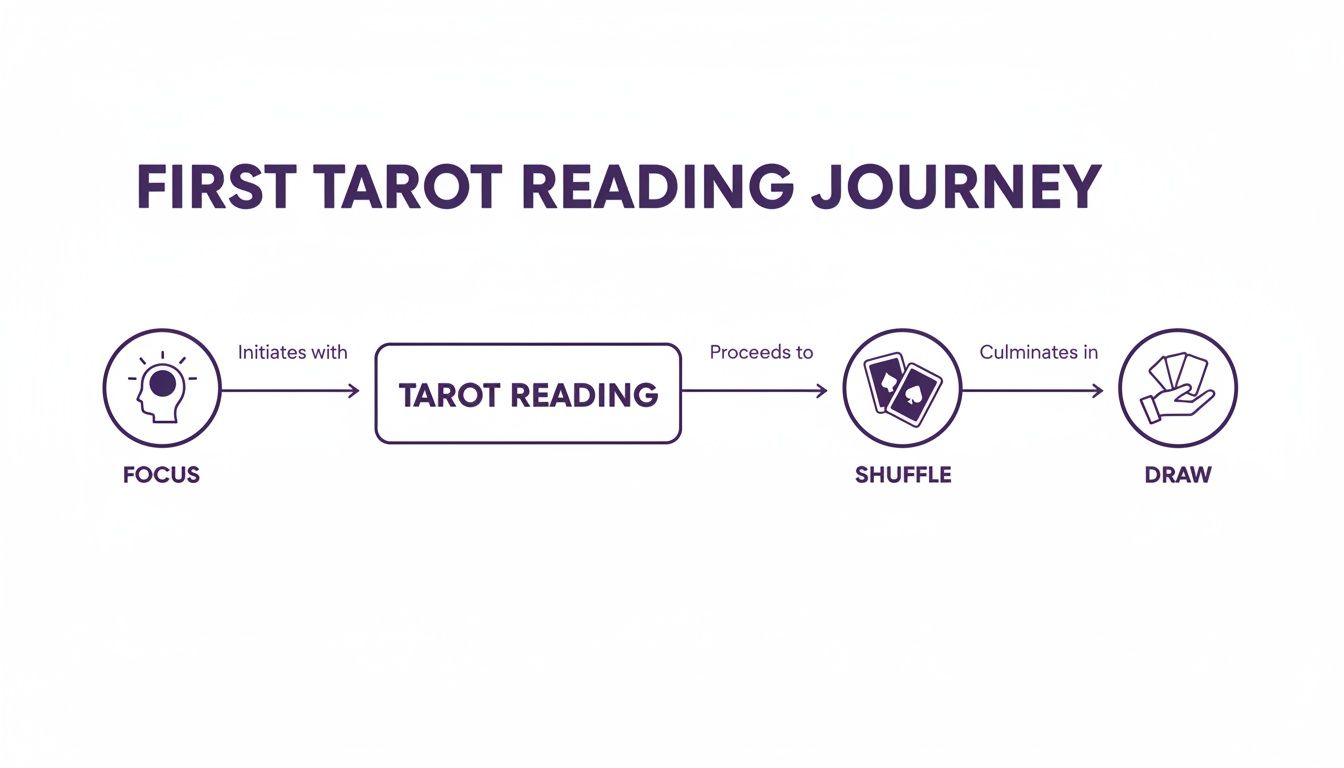
It’s a great reminder that a good reading begins with your own internal focus long before you ever touch the deck. With that in mind, let’s explore two essential spreads that will give your insights a reliable home.
The Classic Three-Card Spread
The three-card spread is the absolute bread and butter of tarot. It’s incredibly versatile, a breeze to remember, and you can adapt it to answer almost any question you throw at it. Its real power is in its simplicity; it gives you a clear beginning, middle, and end.
The most common way to read it is:
- Card 1 (The Past): This card points to the background of the situation. What events or energies brought you to this point?
- Card 2 (The Present): This reflects what’s happening right now—your current circumstances, challenges, or headspace.
- Card 3 (The Potential Future): This shows a likely outcome if things keep moving on their current path. Remember, it’s not a fixed destiny, just a glimpse of what could be.
Let's say you ask, "What do I need to know about my career path?" You might pull The Tower (Past), the Eight of Pentacles (Present), and The Star (Future). That tells a powerful story: a sudden, disruptive change in the past (The Tower) has led you to focus on diligently honing a new skill right now (Eight of Pentacles), with a very hopeful, inspiring future ahead if you stick with it (The Star).
The three-card spread is your go-to for quick, clear insights. It teaches you to see how energy flows across time, which is key for building your confidence in weaving a narrative from the cards.
Approaching the Celtic Cross Spread
Ah, the Celtic Cross. It's one of the most famous and detailed spreads out there, but its ten-card layout can look pretty intimidating at first. The secret is to stop trying to memorize ten separate meanings. Instead, see it as a story that builds on itself, one position at a time.
A much easier way to learn it is to break it into two parts: a central cross of six cards that gets to the heart of the matter, and a vertical "staff" of four cards that adds context and advice.
The Heart of the Matter: The Central Cross
This first group of six cards gives you a 360-degree view of what's going on.
- Position 1 (The Present): The core of the situation right now.
- Position 2 (The Challenge): The immediate obstacle crossing your path.
- Position 3 (The Foundation): The deep-seated roots of the issue, often subconscious.
- Position 4 (The Recent Past): Events that just happened and led directly to today.
- Position 5 (The Potential Outcome): What's possible if you stay on the current track.
- Position 6 (The Near Future): The very next step or event likely to happen.
The Broader View: The Staff
These last four cards zoom out to provide external context and guidance.
- Position 7 (Your Role): Your own attitude and how you're influencing things.
- Position 8 (External Influences): The people, environment, or outside energies affecting you.
- Position 9 (Hopes and Fears): Your underlying hopes or anxieties about it all.
- Position 10 (The Final Outcome): The ultimate resolution or the long-term result.
When you're starting, just practice with the six-card central cross. Get really comfortable telling that core story. Once you’ve got the hang of it, you can add the final four cards to flesh out the reading. This step-by-step approach lets you master a powerful spread without the overwhelm.
To make things even clearer, here’s a quick comparison of when to use these two essential layouts.
Beginner-Friendly Tarot Spreads
| Spread Name | Number of Cards | Best For | Key Focus |
|---|---|---|---|
| Three-Card Spread | 3 | Quick daily check-ins, straightforward questions, exploring a single issue. | Understanding the flow of energy from past to present to a potential future. |
| Celtic Cross Spread | 10 | Deep-dive questions, complex situations with many moving parts, relationship dynamics. | A comprehensive, multi-layered look at a situation from all angles. |
Ultimately, the three-card spread gives you a sharp snapshot, while the Celtic Cross offers a detailed panorama. Both are invaluable tools to have in your tarot toolkit.
Learning to Interpret Cards and Trust Your Intuition
You’ve got the deck structure down and you know how to lay out a spread. Now comes the real work—and the real magic. This is where you breathe life into the images in front of you. Memorizing card meanings is a solid starting point, but the most powerful readings happen when you let go of rigid definitions and start a conversation with the cards.
Think of each card's textbook meaning as just one note in a song. Your job is to listen to how all those notes harmonize, clash, and weave together to tell a unique story. This is where you learn to trust that quiet inner voice.
The goal isn't just to "read" what the cards say. It's to interpret them. This means you have to look closer at the imagery, notice the symbols that jump out at you, and pay attention to the thoughts and feelings that surface as you take in the whole picture.
Moving Beyond Memorization
The first step to building your interpretive skill is giving yourself permission to see more than what the little white book tells you. An artist chose every color, symbol, and figure for a reason. Your personal connection to that art isn't just valid—it's a vital part of the reading.
Before you even think about reaching for a guide, look at a card and ask yourself a few simple questions:
- What's the very first thing that catches my eye? Is it a splash of color, a strange object, or the look on someone's face?
- What's the overall mood here? Does it feel tense, hopeful, peaceful, or completely chaotic?
- What story does this picture seem to be telling? If this was a single frame from a movie, what happened right before this moment, and what might happen next?
This is how you start building your intuitive muscle. You’re training your brain to find personal meaning in the symbols, which is what makes your readings feel so incredibly specific and resonant. It’s the difference between reciting a definition and telling a story.
How Cards Talk to Each Other
A tarot spread is never just a random collection of cards. It’s a living, breathing conversation. The cards influence one another, shifting their tone and meaning based on who their neighbors are. Learning to spot these connections is what turns a simple reading into a cohesive narrative.
Look for patterns that stretch across the entire spread. A few key things to watch for include:
- Dominant Suits: Do you see a lot of fiery Wands? That might point to a situation all about passion and action. Or are there a lot of emotional Cups, signaling that relationships and feelings are at the core of the issue?
- Recurring Numbers: Seeing multiple Fours could suggest a theme of stability and structure, while a handful of Fives might be a heads-up about conflict and necessary change.
- Gaze and Direction: Pay attention to which way the figures on the cards are looking. Are they facing the past, the future, or looking directly at another card in the spread? This can show you exactly where the energy is flowing.
Trusting your intuition isn't about pulling ideas out of thin air. It’s about synthesizing all the information in front of you—the symbols, the patterns, the classic meanings—and weaving it all into a story that clicks with your own inner wisdom.
The modern boom in tarot has made this learning process so much more accessible. With over 29.9 million posts under the #tarot hashtag on Instagram alone, a huge global community is right at your fingertips. This gives beginners a chance to quickly compare interpretations, share their own insights, and find resources that help bridge the gap between just memorizing and truly understanding.
When you learn to see the connections between cards, you start to read the story of the spread, not just the individual words. This is the heart of a tarot practice that is deeply personal and genuinely insightful.
Avoiding Common Mistakes on Your Tarot Journey
Every new tarot reader hits a few bumps in the road. That’s just part of the learning process. But knowing what to look out for can help you build a healthier, more empowering practice from the very beginning. Think of these as friendly signposts to help you steer clear of the frustrations that can easily derail you.
The most common mistake? Treating the cards like a magic 8-ball that dictates your life. Tarot is a tool for reflection and guidance, not a substitute for your own judgment. It should empower you, not create a cycle of dependency where you feel you can't make a move without consulting your deck.
A healthy practice means using the cards to explore possibilities, not to seek permission. If you find yourself pulling cards for every minor decision—like what to have for lunch—it might be a sign to take a step back and reconnect with your own inner voice.
Reframing Scary Cards
Sooner or later, you're going to pull a card that looks terrifying. The Tower, with its imagery of lightning and destruction, or the stark finality of the Death card can send a shiver down anyone's spine. A beginner's immediate reaction is often fear, but this is one of the most important hurdles to overcome.
These cards are not literal predictions of doom. They are powerful archetypes that represent necessary change and transformation.
- The Death card almost never signifies a physical death. Instead, it points to the end of a major cycle—a job, a relationship, a belief system—that is making way for something new to begin. It's about shedding an old skin.
- The Tower represents a sudden, often disruptive, revelation. It's that "aha!" moment that shatters a false foundation so you can rebuild on something more authentic and solid.
Seeing these cards is an opportunity. They signal that you are on the verge of significant personal growth, even if the process feels challenging at the moment.
"A common pitfall is the fear of 'bad' cards. In truth, tarot doesn't have good or bad cards—only messages. The Tower isn't a curse; it's a catalyst for liberation from something that wasn't working anyway."
Asking the Right Kind of Questions
Another frequent stumble is asking questions that are either too vague or too specific. A question like, "Will I be happy?" is too broad for the cards to give a meaningful answer. On the flip side, asking, "Will I hear back from the job I interviewed for on Tuesday at 3 PM?" is too narrow and misses the point of tarot's reflective power.
The sweet spot is asking open-ended questions that focus on your role in the situation. This shifts the dynamic from passive fortune-telling to active problem-solving. It's a key step in any effective tarot reading for beginners.
Instead of asking, "Will I meet someone soon?" try reframing it:
- "What mindset or energy can I cultivate to attract a healthy relationship?"
- "What inner blocks might be preventing me from forming a connection?"
This simple change turns the reading from a passive waiting game into an active strategy session. It puts the power to create change right back where it belongs: with you.
Common Questions from New Tarot Readers
As you get started with tarot, you're going to have questions. That’s not just normal—it’s a sign you’re really digging in. Getting a few of these common uncertainties out of the way will help you build confidence and trust your intuition.
What if My Reading Makes No Sense?
It happens to all of us. You lay out the cards, and they seem completely random or have nothing to do with what you asked. Don't panic. This is a classic beginner's hurdle.
When this happens, take a breath and just look at the spread as a whole picture. Do you see a lot of one particular suit? A repeating number? Sometimes, the cards aren't answering your surface-level question but are pointing to the real issue underneath it—the one you haven't even put into words yet. Let it sit for a while. The true meaning often clicks into place hours or even days later when you’re not trying so hard.
How Do I Choose My First Tarot Deck?
The right deck is simply the one that calls to you. Seriously. Forget that old rule about your first deck needing to be a gift. In this day and age, choosing your own deck is a deeply personal and empowering first step.
Look for artwork that sparks something in you. When you have a genuine visual connection to a deck, learning its unique language feels less like studying and more like getting to know a friend. The Rider-Waite-Smith deck is a classic for a reason—its imagery is so foundational that it provides a great springboard into most modern decks.
The most important thing about your first deck isn't its historical significance or what’s popular. It's your gut connection to it. Pick the art that makes you curious and eager to hear its stories.
Do I Need to Cleanse My Deck?
Think of cleansing your deck as hitting the reset button. It’s a simple way to clear out old, stagnant energy from past readings, especially if other people have been touching your cards. And no, it doesn't require a big, elaborate ritual.
Here are a few easy ways to cleanse your deck:
- Shuffle with Intention: As you shuffle, just visualize any leftover energy dissolving and leaving the cards fresh.
- Knock: Give the stacked deck a few firm but gentle knocks. It's like physically knocking the energetic dust off.
- Put It in Order: Take the time to sort all 78 cards back into their original sequence, from The Fool all the way to the King of Pentacles.
For anyone who wants to go deeper into building a meaningful practice, you can learn more about our philosophy and approach to tarot for some added perspective.
At askyourtarot, our mission is to offer clear, compassionate guidance to help you find your own answers. If you feel you’d benefit from the insight of a trusted reader, we’re here to help.