How to Read Tarot Cards A Beginner's Practical Guide
Reading tarot cards is a way of tapping into your own inner wisdom using a 78-card deck as a guide. The process is a personal ritual: choosing a deck that truly resonates with you, clearing its energy, and focusing on a question or intention. From there, you'll shuffle, draw the cards into a layout (called a spread), and interpret the rich imagery to tell a story.
It’s less about predicting a locked-in future and more about getting a clearer picture of your present situation.
Your First Steps into The World of Tarot
So, you're feeling the pull of the cards. Welcome. Let’s get one thing straight right away—learning to read tarot isn’t about memorizing 78 rigid definitions or having some kind of special psychic gift.
It’s a practice of connecting with your own intuition. It’s for anyone willing to learn the symbolic language of the cards. Think of your deck not as a crystal ball, but as a mirror. It reflects your inner thoughts, subconscious patterns, and the potential paths shimmering just ahead of you. When you're feeling stuck, it’s an incredible tool for finding clarity.
Choosing a Deck That Speaks to You
Your first deck is a big deal. It should feel like a deeply personal choice, not something you should get. While the classic Rider-Waite-Smith deck is the go-to for beginners because its imagery is so direct and traditional, the most important thing is that you connect with the art and vibe of the cards.
Here’s what I tell people to look for when they’re searching for their deck:
- Imagery: Do the pictures grab you? Do they make you feel something or spark a story in your mind? A deck with rich, detailed scenes will make interpretation feel much more natural than one with minimalist art.
- Theme: Decks come in every theme imaginable, from cats and ancient folklore to modern art and botanical illustrations. Find one that genuinely reflects your own interests.
- Feel: If you get a chance to hold the deck before buying it, pay attention to the cardstock. You’ll be shuffling these cards a lot, so you want them to feel good in your hands.
Cleansing and Setting Your Intention
Once you’ve found your deck, it's time to make it truly yours. Think of this as clearing out any leftover energy from its creation, packaging, and journey to you. This "cleansing" process tunes the deck to your personal frequency, getting it ready for your unique questions.
A new deck is like an unplayed instrument. Cleansing and setting an intention is the process of tuning it. You are calibrating it to your own frequency so that the music—the messages—it produces is clear, resonant, and truly yours.
The simplest cleansing methods are often the best. You can give the deck a few firm knocks, pass it through sage or incense smoke, or just hold it in your hands and visualize a clean, white light washing away old energy.
After it feels clear, hold the cards close and set your intention. You could say something simple like, "I intend for this deck to be a tool for clarity, wisdom, and self-understanding." This little ritual creates a focused, respectful space for your readings. For more personalized guidance on starting your journey, the experts at https://askyourtarot.com/ can offer valuable insights.
Connecting with Your Deck: Shuffling and Spreads
Alright, your deck is cleansed and your intention is clear. Now for the fun part—actually handling the cards. Shuffling isn't just about randomization; it's a small ritual. This is the moment you pour your own energy, questions, and focus into the deck, turning it from a simple stack of cards into a partner in conversation.
Some people love a crisp, casino-style riffle shuffle. Others, like me, prefer a more organic, messy pile shuffle where you just spread the cards out and mix them up. There’s no right way to do it. The only thing that matters is finding a method that feels right in your hands and helps you zero in on your question.
This flow is the foundation for every single reading you'll ever do: choose your deck, cleanse its energy, and set a clear intention.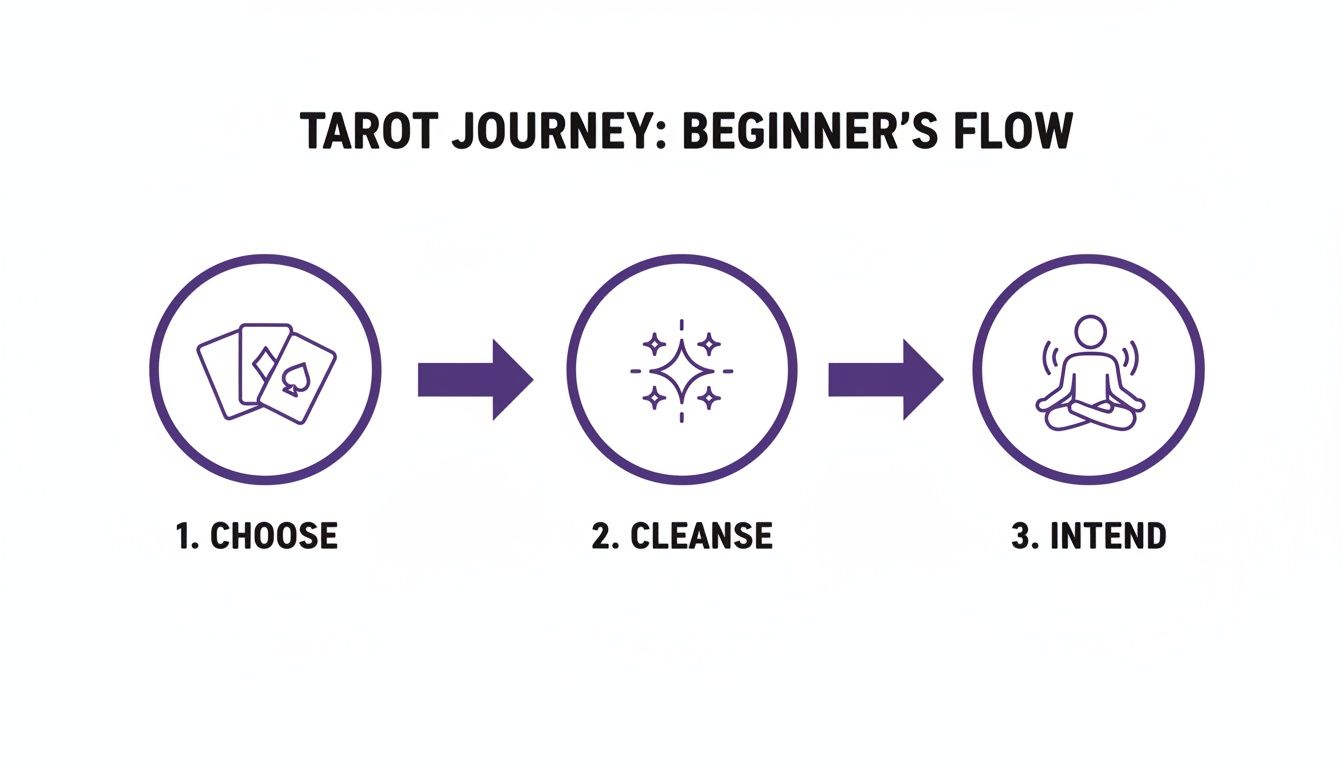
Nailing this simple, three-part process ensures you start every session from a place of clarity. That alone is the key to a powerful reading.
Finding Your Shuffling Rhythm
The physical act of shuffling is what wakes the deck up for your reading. As your hands move, let your question fill your mind. Feel the energy of your thoughts transfer from you into the cards you’re holding.
A few popular techniques you can try:
- The Overhand Shuffle: Simple and effective. Hold the deck in one hand and use the thumb of your other hand to slide small packets of cards off the top. It's gentle on your deck and great for meditative focus.
- The Riffle Shuffle: You know this one—split the deck in two and let the corners weave together. It gives a great mix, but be warned, it can bend your cards over time. Be gentle.
- The Pile Shuffle: My personal favorite for a new deck. Just lay the cards face down on a clear surface and mix them all around. This is perfect for breaking up any stuck energy and getting a truly fresh start.
How long should you shuffle? Until it feels right. Seriously. You'll get an intuitive nudge—a sense of calm, a sudden urge to stop, or a feeling that the deck is "ready." Trust that feeling.
Laying the Foundation with Tarot Spreads
Once you've stopped shuffling, you'll lay the cards out in a specific pattern called a spread. Each spot in a spread has a specific meaning, giving you a framework to build a story from the cards you draw. Spreads are what turn a few random cards into a coherent narrative.
When you're starting out, keep it simple. Jumping into a massive, complicated spread is a recipe for overwhelm. Think of it like learning your scales before attempting a symphony.
A tarot spread is like a storyboard for your intuition. Each card position is a frame, and together, they tell a dynamic story about where you've been, where you are now, and the potential paths that lie ahead.
The most essential spread for any beginner is the three-card spread. It’s incredibly versatile, easy to understand, and gives you a surprising amount of insight.
Your First Reading: The Three-Card Spread
This spread is your new best friend for getting clear answers to specific questions. It gives you a quick snapshot of the energy surrounding your situation. The positions are refreshingly straightforward:
- Card 1 (Past): This card points to past events or influences that created the current situation. It's the "how you got here."
- Card 2 (Present): This card is the heart of the matter. It reflects what’s happening right now and the core energy you're dealing with.
- Card 3 (Future): This card shows a potential outcome or the direction things are moving if you stay on the current path.
Let's say you're asking about a creative project that feels stalled. Your first card might show past excitement, the second could reveal your current burnout, and the third might suggest that collaboration is the key to moving forward. See? A clear, actionable story.
As you build confidence, you can move on to more complex layouts. The classic Celtic Cross, which uses 10 cards, is a fantastic next step for digging into the deeper, subconscious factors at play. But before you get there, master the basics. Shuffling, laying the spread, and telling the story—that's the core of it. Some readers, about 50% of professionals according to an in-depth analysis of tarot trends, also read reversed (upside-down) cards to spot blocked energy. It adds nuance, but you can absolutely ignore reversals when you're just starting out. Focus on the fundamentals first.
Learning the Language of The Major and Minor Arcana
Think of the tarot deck as a storybook with 78 pages, each illustrating a part of the human journey. Some pages depict those huge, earth-shattering moments, while others capture the everyday feelings and situations we all know. Getting a feel for how this "book" is organized is the first real step to reading with confidence.
The deck is divided into two main sections: the Major Arcana and the Minor Arcana. Understanding the distinct role each one plays is what separates memorizing keywords from actually speaking the language of the cards.

This structure isn't just for show; it’s a map of our experience. Once you get the hang of navigating it, individual card meanings start to fall into place almost effortlessly.
The Major Arcana: Your Spiritual Compass
The Major Arcana is made up of 22 trump cards that represent the big, universal themes of life. These are the showstoppers. When one of these lands in a reading, it’s a clear signal to pause and pay attention. They point to major life lessons, spiritual turning points, and powerful archetypal forces at work.
If your life is a novel, the Major Arcana cards are the pivotal plot points—the big chapters, the dramatic twists, and the final resolutions.
The Major Arcana cards are like cosmic signposts. When one appears, it’s the universe gently (or sometimes, not so gently) asking you to pay attention to the bigger picture and the profound spiritual journey you are on.
For example, pulling The Fool signifies a new beginning, a leap of faith. The Lovers can point to a critical choice about your relationships or core values. Even the feared Death card isn’t about a literal end; it’s about profound transformation. These cards demand you zoom out and look at the soul-level lesson behind what’s happening.
The Minor Arcana: The Story of Daily Life
While the Major Arcana tackles the big stuff, the 56 Minor Arcana cards get into the nitty-gritty of our daily existence. They reflect the practical actions, thoughts, feelings, and circumstances that color our day-to-day reality. Think of them as the supporting characters and subplots that add richness and context to the main story.
The Minor Arcana is broken down into four suits, each corresponding to a different sphere of human experience. This is where learning to read tarot becomes so much more manageable. Instead of trying to memorize 56 separate meanings, you start by understanding the core energy of just four suits.
Decoding The Four Suits
Each suit has 14 cards: an Ace through Ten, plus the four Court Cards (Page, Knight, Queen, and King). Grasping the element and themes of each suit is an incredible shortcut to a card’s meaning.
To make this easier, here’s a quick reference table breaking down the core themes of each suit.
The Four Suits of the Minor Arcana at a Glance
| Suit | Element | Core Themes | Represents |
|---|---|---|---|
| Wands | Fire | Passion, energy, creativity, ambition | Willpower, action, inspiration, growth |
| Cups | Water | Emotions, intuition, relationships, love | Feelings, connections, creativity, the heart |
| Swords | Air | Thoughts, communication, challenges, truth | Intellect, beliefs, conflict, clarity |
| Pentacles | Earth | Finances, career, health, material world | Work, home, security, manifestation |
This table is a great starting point for quickly identifying the energy at play in your readings.
Wands (Fire): This suit is all about that spark—passion, creativity, energy, and ambition. Wands represent your drive and willpower. When you see a Wand card, think action, growth, and the pursuit of goals.
Cups (Water): Cups dive deep into the world of emotions, relationships, intuition, and love. They speak directly to the heart, reflecting our connections, feelings, and creative expression. A reading heavy in Cups is all about matters of emotional significance.
Swords (Air): This suit represents the realm of the mind. Swords are about thoughts, communication, challenges, and beliefs. They bring sharp clarity and truth but can also point to conflict and tough decisions, reflecting the double-edged nature of our intellect.
Pentacles (Earth): Pentacles are grounded in the material world. They deal with finances, career, physical health, and your home life. These cards speak to the tangible results of your efforts and your connection to the physical plane.
By simply identifying a card's suit, you've already unlocked a huge piece of its message. The Ten of Wands, for example, points to being crushed by responsibilities (Wands' fiery energy taken to an extreme), while the Ten of Cups signifies blissful emotional fulfillment (Cups' watery energy at its peak). This framework makes learning tarot feel less like memorization and more like an intuitive conversation.
Alright, you've got the basics down. You know what the suits mean and you've met the characters of the Major Arcana. But here's the thing: knowing the dictionary definition of the Eight of Wands is one thing. Understanding what it means when it shows up next to The Hermit? That's where the real magic happens.
Reading tarot isn't about memorizing flashcards. It’s more like learning to conduct an orchestra. Each card has its own sound, but the art is in weaving them together into a story that makes sense—a story that feels true. This is where your intuition gets to step up and run the show.
Seeing the Bigger Picture
Before you dive into analyzing each card one by one, just take a breath and look at the whole spread. Zoom out. What’s the vibe? Does it feel heavy and difficult, or is there a sense of lightness and hope?
Look for the patterns that practically jump out at you. These are the threads that tie the entire reading together.
- Dominant Suits: Is there a flood of Cups on the table? The reading is almost certainly about emotions, relationships, and matters of the heart. A spread loaded with Pentacles, on the other hand, is pointing you toward practical, earthly stuff—your job, your home, your money.
- Recurring Numbers: Did you pull two or three "Fours"? This number is all about stability and structure. Seeing it pop up repeatedly might be a nudge to build a stronger foundation, or it could be a warning that you're feeling a bit boxed in.
- Major vs. Minor Arcana: Count the Major Arcana cards. If your reading is heavy with them, you’re not just dealing with day-to-day hiccups. The universe is signaling big life lessons, soul-level shifts, and major themes at play.
This first glance gives you the context for everything else. It’s like knowing you’re about to watch a comedy versus a drama—it frames the whole story.
The Truth About Reversed Cards
Sooner or later, a card is going to show up upside down. This is called a reversal, and it tends to freak beginners out. It's easy to assume it's a "bad" sign or that something is wrong.
Let's clear that up right now: a reversed card is not a bad omen.
Think of it as the deck leaning in and whispering, "Hey, pay attention to this one." A reversal often points to energy that's blocked, stuck, or being turned inward. It’s a spotlight shining on an area that needs your focus.
A reversed card is simply a whisper from the deck saying, "Hey, look over here. This energy is important, but it’s not flowing freely yet. Let’s figure out why."
Take The Sun, for example. Upright, it's pure joy, success, and clarity. Reversed, it doesn't mean you're doomed. It might just mean you’re struggling to see the bright side, or perhaps your inner critic is casting a shadow over your accomplishments. It’s an invitation to look within and find what’s blocking that sunny energy.
Walkthrough a Three-Card Reading
Let's put this all into practice. Imagine you sit down with your deck and ask, "What do I need to know about my current career path?"
You shuffle, concentrate, and pull three cards for a simple Past-Present-Future spread.
Your Draw:
- Past: Eight of Pentacles
- Present: The Hanged Man
- Future: The Fool (Reversed)
Time to connect the dots.
1. The Past (Eight of Pentacles):
This card screams hard work and dedication. In your recent past, you've been head-down, mastering your craft, and putting in the hours. You've been diligent and focused on the details.
2. The Present (The Hanged Man):
And now... a screeching halt. This Major Arcana card signals a necessary pause. Despite all that hard work, you're at a standstill. You feel suspended, stuck, and unable to make a move. This isn't a punishment—it's a cosmic timeout, asking you to surrender control and look at things from a totally different angle.
3. The Future (The Fool - Reversed):
Here's our reversal. Upright, The Fool is all about taking a joyful, spontaneous leap of faith. Reversed, it points to a major hesitation. There’s a fear of looking silly, of making a mistake, or of starting something new without having all the answers.
Putting the Story Together:
When you weave these together, a clear narrative emerges. "You've worked incredibly hard and built real expertise (Eight of Pentacles). But right now, you're in a necessary holding pattern where pushing forward won't help (The Hanged Man). The way out is to take a leap into something new, but a fear of the unknown is holding you back (The Fool Reversed)."
See? It's not a rigid fortune. It’s a powerful insight. The cards are telling you this feeling of being stuck is purposeful, and your next step requires embracing a new beginning, even if it feels a little reckless.
This kind of storytelling is the heart of tarot. It's a skill that's becoming more and more valued in a market that's booming. The Tarot Cards Industry is forecasted to hit USD 1.8 billion by 2030, and choosing the right deck is a huge part of the journey. In fact, around 70% of beginners lean on the classic Rider-Waite-Smith deck because its rich imagery makes learning these narrative skills so much easier. You can check out more on the industry's growth from these market insights.
Deepening Your Practice and Reading with Integrity
You've learned the language of the cards. Now the real journey begins—moving from knowing the deck to living with it. This is where you shift from a beginner to a confident reader, and it’s all about practice and building a strong ethical compass.
It’s not about becoming a master overnight. It’s about consistently showing up for your deck and, more importantly, for yourself.
Think of it like learning to play an instrument. You don't just read the sheet music once. You have to play the scales, practice the chords, and let the music seep into your muscle memory. Tarot is the exact same. That consistent effort is what builds your intuitive muscle and turns head-knowledge into genuine wisdom.
Building Your Intuitive Muscle
The secret ingredient here is daily practice. And no, this doesn't have to be some elaborate, hour-long ritual. A simple, focused exercise can deepen your connection to the cards far more than cramming on the weekends.
Here are a couple of simple but incredibly powerful exercises to try:
- The Daily Card Pull: Every morning, pull a single card. Ask it, "What energy or lesson should I focus on today?" Don't get stuck in your head trying to analyze it to death. Just look at the image, feel its message, and carry that thought with you through your day.
- Keep a Tarot Journal: This is an absolute game-changer. Jot down your daily draws, the questions you asked, and what you initially thought the card meant. Later, you can look back and see how that card's energy actually showed up in your life. This practice builds a personal, experience-based library of card meanings that is way more potent than any guidebook.
Over time, you'll find you're not just learning about tarot cards; you're learning the patterns of your own life through the lens of the cards.
The Ethics of Reading for Yourself and Others
With the ability to read tarot comes a real responsibility to do it with integrity. This holds true whether you're pulling a card for yourself on a tough day or reading for a friend who’s in a tight spot. Ethical reading is about empowerment, not just prediction.
The recent surge in interest around spiritual tools really highlights this need. A 2025 Pew Research study found that a staggering 30% of U.S. adults consult spiritual guides like astrologers or tarot readers at least once a year. That number jumps to nearly 25% for young adults aged 18-29, many of whom start their journey online. This growing audience deserves responsible guidance; you can see more by exploring the Pew Research findings on spiritual practices.
Tarot is a tool for illumination, not a sentence. The goal of an ethical reading is to hand the power back to the querent, offering them clarity and perspective so they can make their own empowered choices.
Here are the core principles I live by in my own practice:
- Frame Empowering Questions: Ditch the fortune-telling questions like, "Will I get the job?" Instead, try asking, "What can I do to present my best self in the interview?" This simple shift moves the focus from a passive outcome to active participation.
- Avoid Rigid Predictions: The future isn't set in stone. A reading is just a snapshot of the current energy and a potential path forward. Always, always present the outcome as a possibility, not a certainty.
- Respect Privacy: Never, ever read for a third party without their explicit consent. Your reading should focus on the person sitting in front of you and their role in a situation, not on trying to uncover someone else's private thoughts or feelings.
Navigating Common Pitfalls for New Readers
Every new reader stumbles. It’s part of the process. Knowing the common traps can help you navigate them with a bit more grace and keep your practice healthy.
One of the biggest hurdles is relying too heavily on the guidebook. It's a fantastic starting point, but it's not the final word. Your intuition is. Trust the story you see in the images first, and then see what the book has to say.
Another huge pitfall is reading when you're an emotional wreck. If you're highly anxious or upset, your cards are just going to reflect that chaotic energy right back at you, leading to confusing or fear-based interpretations. If you're not in a clear headspace, it’s always better to step away and come back later. This dedication to clarity and ethical practice is central to our philosophy, and you can learn more about our mission and trusted advisors.
Common Questions About Learning Tarot
As you dive into the beautiful, complex world of tarot, it’s only natural for questions to bubble up. Every single reader started right where you are, full of curiosity and maybe a little bit of uncertainty. Let's walk through some of the most common hurdles new readers face, so you can move forward with confidence.
Remember, learning how to read tarot cards is a personal journey, not a race. It unfolds at its own pace.
How Long Does It Take to Learn Tarot Cards?
Honestly? There's no finish line. You can start pulling cards and getting simple, insightful messages in just a few weeks. But true fluency—that deep, intuitive connection with the cards—is a lifelong practice.
Instead of trying to cram all 78 cards into your brain at once, focus on just a few at a time. Journal your interpretations. The real skill isn't about rote memorization; it's about building a relationship with your deck and learning to trust those little intuitive nudges you get. Let it be a slow, enjoyable process of discovery.
Do I Need to Be Psychic to Read Tarot?
Not at all. Think of tarot as a visual language, a system of symbols and archetypes that anyone can learn to interpret. Your guidebook is the dictionary, but with practice, you'll start forming your own sentences and telling your own stories with the cards.
Reading tarot is really about intuition—that gut feeling everyone has access to. The cards simply provide a structured framework to help you tap into your own inner wisdom.
Tarot is a mirror for your intuition. It doesn't require you to be psychic; it simply asks you to be present, open, and willing to listen to the wisdom you already hold within.
Of course, if you ever feel like you need an outside perspective or want to see how an experienced reader puts it all together, don't hesitate to reach out. You can always connect with a professional by visiting our contact page to ask your own questions.
What if I Draw a Scary or Negative Card?
It’s completely normal to feel a jolt of anxiety when cards like Death or The Tower show up in a spread. But here’s the thing: in tarot, there are no truly "bad" cards. There are only challenging lessons that invite us to grow. These cards represent universal human experiences that are a necessary part of life.
Let's look at what they really mean:
- The Tower: This card rarely predicts a literal disaster. Instead, it signals a sudden, necessary clearing of old structures that no longer serve you. It’s making way for something much more authentic to be built in its place.
- Death: This card almost never points to a physical death. It signifies the end of a cycle—a job, a relationship, a belief system—that is paving the way for a powerful rebirth.
Try to see these cards as signposts for transformation, not as warnings of inevitable doom. They are invitations to look deeper at what needs to change in your life for you to evolve. Every single card, no matter how intimidating it first appears, holds a key to your empowerment.
Your journey with tarot is a deeply personal one, filled with insight and self-discovery. If you ever feel stuck or desire a deeper level of clarity on your path, the trusted advisors at askyourtarot are here to help. Our vetted readers provide thoughtful, personalized readings to illuminate your most important questions. Explore our readers and book a session today at https://askyourtarot.com.